


Key takeaway: the temperature curve confirms ovulation thanks to progesterone, which raises the body's temperature by 0.3 to 0.5°C. This daily monitoring helps to validate the fertile period and detect a possible pregnancy if the plateau remains high for 18 days. A rise of three consecutive temperatures compared to the previous six mathematically signals the end of the process.
Do you feel lost with irregular cycles or tests that never show positive? Monitoring your ovulation temperature curve is a natural and free solution to finally understand what is happening in your body each morning. In this guide, I will explain how to interpret your thermal plateaus and use progesterone as a reliable compass to confirm your fertility with peace of mind.
- The direct link between your hormones and your temperature curve
- 5 tips for reliable temperature taking upon waking
- Deciphering your chart to identify ovulation
- Managing the interpretation of results with kindness
The direct link between your hormones and your temperature curve
Your body is not a fixed machine, but a living ecosystem that constantly reacts. Fluctuations in your hormones create real internal heat variations throughout the month.
The action of progesterone on your body heat
Progesterone acts as a real natural heating hormone. It is secreted by the corpus luteum just after the release of your egg. This biological process modifies your metabolism.
The thermal impact is then concrete and immediate. Your temperature rises suddenly. It is a clear biological signal for those who know how to observe it every morning.
The amplitude remains slight but perfectly visible. A jump of between 0.3 and 0.5 degrees Celsius is generally observed. This small difference changes everything.
This rise confirms ovulation. It is your thermal proof.
The two distinct phases of your menstrual cycle
The follicular phase constitutes the beginning of your cycle. This is the low plateau where estrogens largely dominate. Your temperature remains stable and rather cool before the big jump.
Then, the high plateau takes over. It starts precisely after ovulation. This luteal phase lasts on average fourteen days in most women.
You can also learn how to predict your baby's sex with a global and benevolent natural approach.
The contrast draws your ovulation temperature curve. It is a true hormonal identity card.
5 tips for reliable temperature taking upon waking
Now that the theory is clear, let's move on to practice, because the accuracy of your chart depends entirely on your morning rigor.
Choosing the right thermometer and measurement method
Forget the old alcohol thermometer. You need a specific basal model. Accuracy to two decimal places is essential to see micro-variations.
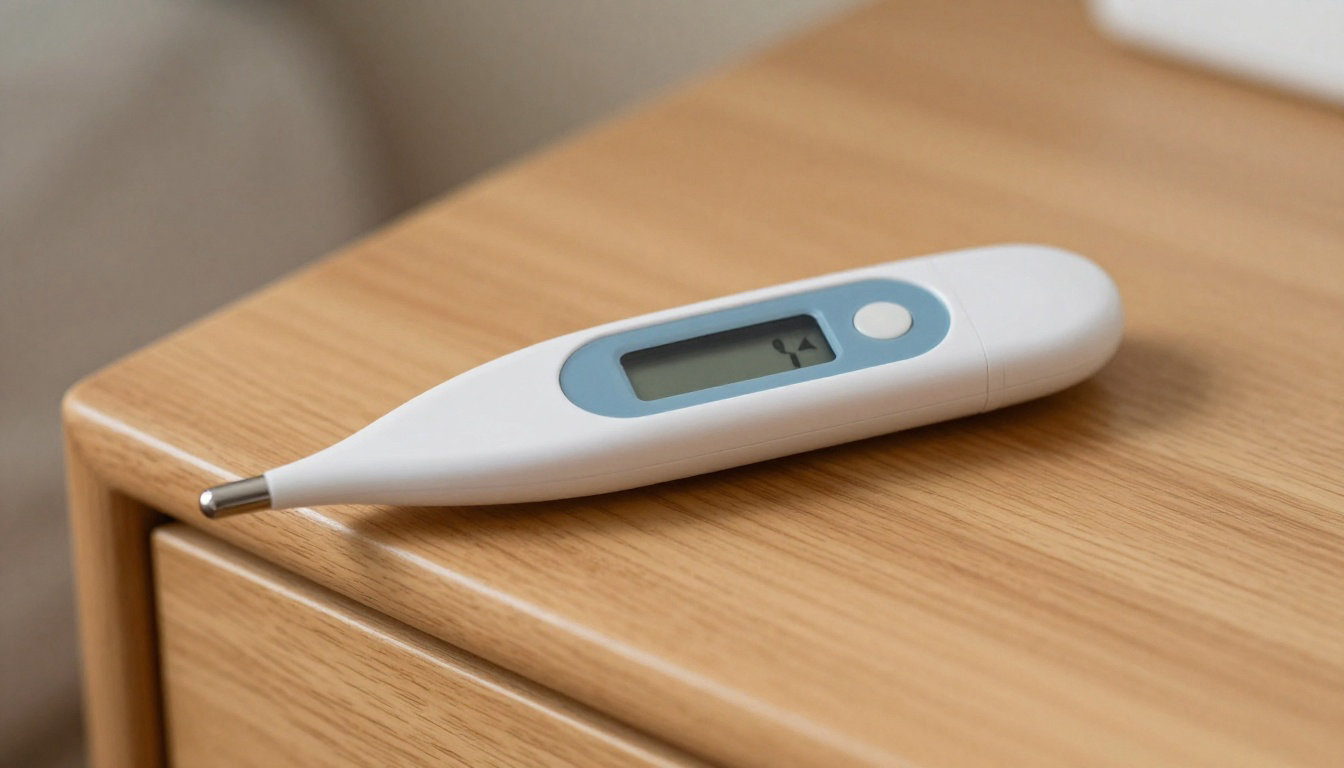
The measurement method is a personal but definitive choice for the cycle. Rectal or vaginal are the most reliable. Oral remains too susceptible to drafts.
| Method | Reliability | Comfort | Recommendation |
|---|---|---|---|
| Rectal | Maximum | Average | First choice for precision |
| Vaginal | Excellent | Good | Reliable alternative |
| Oral | Average | Excellent | Less rigorous |
Never change your method midway through. Consistency is your only ally for a readable chart.
Respecting rest and regularity conditions
The golden rule is total immobility. Take your temperature before even setting foot on the ground. Do not drink water. Do not speak. Your body must remain in its purest state of rest.
The fixed time is non-negotiable. A one-hour shift can skew the result. Set your alarm, even on weekends. This is the price of accuracy.
- Take upon waking
- Remain lying down
- Same time
- Minimum 5 hours of sleep
- Note immediately
Fragmented sleep disturbs the thermal baseline. Aim for at least three consecutive hours of rest.
Deciphering your chart to identify ovulation
Once the points are noted in your notebook or app, it's time to play detective to spot the crucial moment.
Spotting the thermal shift between plateaus
Look for the lowest point on your curve. This is often where ovulation is hidden. Immediately after, the rise should be clear and sustained for several days.
Ovulation is confirmed retrospectively. You need to observe three consecutive temperatures higher than the previous six. This is the mathematical rule.
Don't panic if the rise is gradual. Some women experience a stepwise ascent. The essential thing is the sustained maintenance in the high zone of the chart.
Your chart tells a story. Learn to read between the lines of these daily points.
Using cervical mucus as a complementary sign
Temperature doesn't warn, it confirms. To anticipate, observe your cervical mucus. When it becomes stringy like egg white, ovulation is approaching. This is the signal to optimize your chances of conception now.

Sperm can survive for several days in this fertile environment. Don't wait for the thermal rise to have intercourse.
Arrange a harmonious and stimulating children's room to plan ahead serenely.
Combining these two indicators makes your monitoring foolproof. This is the simplified symptothermal method.
Managing the interpretation of results with kindness
Fertility monitoring is a powerful tool, but it should never become a stressful burden or an unnecessary source of anxiety.
Recognizing pregnancy or an anovulatory cycle
If your high plateau exceeds eighteen days, that's a good sign. A temperature that remains elevated often signals good news. The test then becomes a formality.
Know that dreaming of being pregnant can sometimes accompany these disturbing and wonderful physical signs. Listen to your deep intuition during this period.

A flat curve indicates an anovulatory cycle. This sometimes happens, even in fertile women.
If this recurs, talk to your gynecologist. The curve is excellent medical support.
Dealing with the unexpected and restless nights
Real life often intervenes in your charts. An overly boozy dinner, a cold, or a bad night can artificially raise your temperature. Note these events on your chart so as not to interpret false heat peaks.
Be kind to yourself. Forgetting to take it once doesn't undo all your previous efforts. Simply continue the next day.
The goal is to understand your overall rhythm. Don't fixate on an isolated point.
Stay zen and listen to your sensations. Your body is your best guide.
Mastering your basal body temperature curve confirms your ovulation thanks to the high progesterone plateau. For more reliability, combine this morning ritual with observing your cervical mucus starting tomorrow. Listen to your body with kindness to serenely design your future life project.
FAQ
How do I know if I have ovulated based on my temperature?
To confirm that you have ovulated, you should observe a clear temperature rise, generally between 0.3 and 0.5 °C. This shift creates two distinct phases on your chart: a low plateau before ovulation and a high plateau immediately after.
The golden rule for certainty is to identify three consecutive temperatures higher than the previous six. It is the secretion of progesterone that causes your body temperature to rise, thus confirming that the egg has been released.
Why does my temperature remain high during my period?
It sometimes happens that the mercury does not drop immediately on the first day of the cycle. This can be explained by temporary inflammation, significant stress, or a restless night. Sometimes, progesterone levels that take a little longer to drop maintain this residual heat.
If your temperature remains high and your bleeding is very light, it could also be a sign of early pregnancy. If in doubt, do not hesitate to take a test to be sure and remain calm.
What is the correct method for taking your temperature?
Accuracy is key to obtaining a readable curve. Use a basal thermometer with two decimal places and take your measurement every morning, at a fixed time, before even setting foot on the floor. The slightest movement or a glass of water can skew the result.
For maximum reliability, rectal or vaginal routes are preferable. Immediately note your result and specify if external factors, such as an eventful dinner or lack of sleep, may have disturbed your night's rest.
Can the temperature curve predict ovulation in advance?
This is the slight limitation of this method: temperature confirms ovulation after the fact, but it does not warn of its arrival. It is perfect for understanding your overall rhythm and verifying that your cycles are indeed ovulatory.
To anticipate your fertile days and optimize your chances of conception, I advise you to couple temperature taking with the observation of your cervical mucus. When it becomes stringy, it's time to act!
What does a flat temperature curve mean?
A curve without any thermal shift between two plateaus generally indicates an anovulatory cycle, meaning a cycle where ovulation did not occur. This can happen from time to time, even if you are perfectly fertile.
If this phenomenon repeats over several months, your chart will become a valuable tool to show your gynecologist. It is a concrete basis for discussing your hormonal balance and finding suitable solutions.Temperature curve and ovulation | Complete Guide 2026


